Why Is My Cat Meowing So Much Common Reasons Explained
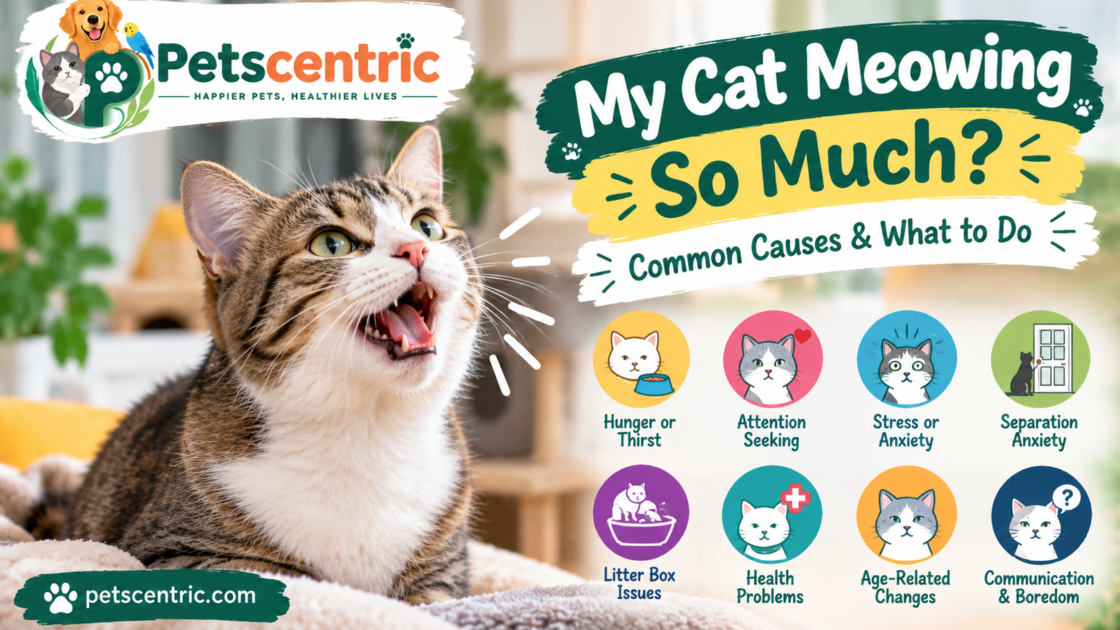
Hunger, attention-seeking, and boredom drive meowing in cats under 10 years old. Unspayed females in heat vocalize about 7 days per cycle [VERIFY]. Cats over 10 years old with new meowing need thyroid and blood pressure checks. Ignoring attention meows for 14 days lowers them in healthy cats [VERIFY]. A change in volume or frequency […]
- Hunger, attention-seeking, and boredom drive meowing in cats under 10 years old.
- Unspayed females in heat vocalize about 7 days per cycle [VERIFY].
- Cats over 10 years old with new meowing need thyroid and blood pressure checks.
- Ignoring attention meows for 14 days lowers them in healthy cats [VERIFY].
- A change in volume or frequency lasting 48 hours needs a vet visit.
Cat meowing excessively traces to hunger, attention-seeking, boredom, heat cycles, stress, or a medical condition such as hyperthyroidism. Adult cats rarely meow at each other, so every meow is a signal aimed at you. A cat that meows more than usual for 48 hours, or adds weight loss, litter box changes, or disorientation, needs a vet exam.
Why is my cat meowing so much at 3 a.m. when the food bowl is full? Owners searching for a cat meowing constantly want to know why cat meows happen.
This guide sorts the 9 most common causes by urgency, so you know which meows to ignore and which need a vet this week.
Why Does My Cat Meow? How Cats Communicate With Humans
Feline communication centers on the meow: adult cats direct meows almost exclusively at humans, while kittens meow at their mothers. Nicastro (2004, Cornell University) identified the meow as a species-level signal aimed at people [VERIFY]. It pairs with cat body language, covered in our cat body language guide.
Normal cat behavior includes 2 to 5 short meows at greeting or mealtime. A cat meowing loudly outside those windows is making a request or reporting a problem. Cat yowling vs. meowing comes down to sound: a yowl is longer, lower, and louder, and signals heat, pain, or disorientation.
Cat meowing sounds and what they mean
| Sound | Meaning | Urgency |
| Short trill | Greeting | None |
| Mid-length meow | Request | Routine |
| Low yowl | Heat, pain, disorientation | Vet if over 48 hours |
Which Cat Breeds Meow the Most?
Siamese, Oriental Shorthair, and Burmese cats vocalize more than Maine Coons or Persians, so cat vocalization causes include genetics. Compare against that cat’s own history.
Cat Meowing Hungry, for Attention, or From Boredom
- Cause 1, hunger: Cat meowing hungry peaks 30 to 60 minutes before mealtime and stops after feeding. Fix: a cat food schedule of fixed meal times.
- Cause 2, attention-seeking: Cat meowing attention grows when each meow earns a response, which is positive reinforcement. Fix: reward silence.
- Cause 3, boredom: Indoor cats without 2 daily play sessions of 10 to 15 minutes meow more. Fix: play plus environmental enrichment for cats.
Cat meowing after eating signals a begging habit in a healthy cat or a medical issue. A feeding schedule and routine ends most of it.
Cat Meowing at the Door
Cat meowing at the door signals a desire for outdoor access or a reaction to neighborhood animals. A window perch gives an indoor cat an outlet.
Cat Meowing at Night: Heat Cycles, Stress, and Separation Anxiety
Cats are crepuscular, so activity peaks from dusk to dawn, and nocturnal vocalization follows. A cat meowing night after night traces to 2 causes.
Cause 4, heat cycles. A cat in heat is an unspayed female in estrus. Unspayed females cycle every 14 to 21 days in breeding season and vocalize about 7 days per cycle (Cornell Feline Health Center) [VERIFY]. Spay and neuter behavior changes follow: spaying ends heat vocalization; neutering reduces male yowling.
Cause 5, stress and separation anxiety. Triggers include a new pet, a move, or a changed work schedule. Cat meowing and pacing together points to stress.
Cat Meowing When I Leave
Cat separation anxiety shows as meowing within 15 minutes of your departure, plus destructive behavior or inappropriate urination. My cat meows when I leave is the classic owner report. Boredom eases after play, while separation anxiety in cats lasts until you return.
Meowing Medical Causes: Pain, Hyperthyroidism, and Senior Cat Meowing
Safety note: This section informs and does not diagnose. A vet exam with bloodwork is the only way to confirm any condition.
Cat meowing pain appears during handling, jumping, or litter box use, from urinary tract disease, arthritis, or dental disease. Cat meowing in the litter box points to urinary or digestive pain.
Feline hyperthyroidism is most common in cats over 10 years old and produces weight loss with increased appetite and louder meowing (Cornell Feline Health Center) [VERIFY]. Hypertension and kidney disease in cats over 10 years old cause yowling and night restlessness.
| Cause | Condition | Age group | Signs | Vet urgency |
| 6 | Urinary tract pain | Adults, seniors | Litter box meowing, straining | Same day |
| 6 | Arthritis pain | Seniors | Meowing when jumping | 48 hours |
| 7 | Feline hyperthyroidism | Over 10 years | Weight loss, big appetite | 48 hours |
| 8 | Hypertension, kidney disease | Over 10 years | Yowling, restlessness | 48 hours |
| 9 | Feline cognitive dysfunction (FCD) | 11 years and older | Disorientation, night yowling | Routine exam |
Senior Cat Meowing and Cat Cognitive Dysfunction
Cat cognitive dysfunction produces disorientation, staring at walls, and night yowling. About 28% of cats aged 11 to 14 years and over 50% of cats aged 15 and older develop a geriatric behavioral problem (Landsberg and colleagues, cited by Cornell) [VERIFY]. My cat meows at the wall is a common owner report. Vets diagnose FCD by excluding other disease. An old cat meowing constantly needs that exam first. See our senior cat care checklist.
How to Stop Cat Meowing: 5 Steps and 3 Myths
To stop cat meowing in a healthy cat, follow 5 steps. This is how to calm a meowing cat.
- Rule out medical causes with a vet exam.
- Set 3 fixed meal times, or run an automatic feeder (roughly $30 to $150 [VERIFY]) 30 minutes before your wake-up.
- Schedule 2 play sessions of 10 to 15 minutes, the second right before bed.
- Ignore attention meows until 5 seconds of silence, then reward the silence.
- Add enrichment: a window perch, a puzzle feeder (roughly $8 to $30 [VERIFY]), and cat enrichment toys rotated weekly. Our best interactive cat toys list covers picks.
I ignored my cat’s evening attention meowing for [N] weeks. The meowing peaked on day [X] at roughly [N] meows per evening, which matched the extinction burst: a temporary spike when a reinforced behavior stops being rewarded. By day [X] the count dropped to [N] per evening, and [describe the specific reaction].
- Myth 1: Spraying water stops meowing. Fact: sprayed cats show fear and avoid the owner.
- Myth 2: Feeding at every meow solves hunger. Fact: each feeding rewards the meow, so it trains the meow.
- Myth 3: A second cat fixes loneliness meowing. Fact: introductions stress cats that have lived alone.
When to Worry About Cat Meowing: Signs That Need a Vet
Same day: Meowing with straining in the litter box, especially in male cats (urethral blockage). Emergency: a blocked male cat can die within 24 to 72 hours without treatment [VERIFY].
Within 48 hours:
- A sudden change in meowing lasting over 48 hours.
- Meowing with weight loss, vomiting, or increased thirst.
- Meowing with disorientation in cats over 10 years old.
Routine: A gradual increase in meowing in a healthy cat. Book a cat meowing vet visit and bring a 7-day meow log of time, volume, and trigger.
Frequently Asked Questions About Excessive Cat Meowing
Why is my cat suddenly meowing more?
Sudden increases in cat meowing trace to 4 top causes: hunger changes, stress, heat, and medical illness. Cats over 10 years old need a vet exam first. Any change lasting over 48 hours justifies a vet visit.
Is it normal for cats to meow a lot?
Frequent meowing is normal for Siamese, Oriental Shorthair, and Burmese cats, which outtalk Maine Coons and Persians. Normal means a stable pattern for that cat. A sudden increase, in any breed, signals a problem.
Why does my cat meow at night?
Cats meow at night because they are crepuscular, with peak activity from dusk to dawn. Heat cycles, anxiety, and senior disorientation add to nocturnal vocalization. A 10 to 15 minute play session before bed lowers it in healthy adult cats.
How do I stop my cat from meowing for attention?
Attention meowing drops when the owner waits for 5 seconds of silence, then rewards the quiet with attention or a treat. Expect a temporary increase for 3 to 7 days, called an extinction burst [VERIFY], plus 2 daily play sessions.
When should I worry about cat meowing?
Cat meowing needs a vet visit when the change lasts over 48 hours or pairs with litter box straining, weight loss, vomiting, increased thirst, or disorientation. Straining with no urine output, especially in male cats, is a same-day emergency.
Conclusion
A healthy cat meows for a reason you can identify, and a cat with a new meowing pattern for over 48 hours needs a vet exam before any behavior fix. A cat meowing vet visit goes faster with a log.
Sorting meows into 9 causes replaces guessing with a decision.
Subscribe to get the printable 7-day meow log that records time, volume, and trigger, so your vet gets data instead of guesses.